Nineteenth Post

IMG_9115 smThank you to everyone who has read my posts.


The Namer and the Named

Breast out. Crawl back.

What would it take to make you happy?

If you connect the dots on my skin
there is a map of Stockholm. The scar
on my knee is in the shape of John Lennon.
My kidneys are twin televisions.

Side out. Side back.

And what do you think would be different
if you changed your name?

I am a Bach sonata. On cold days
I wear plastic bags on my
asparagus feet. Like most people
I take little note of persons in vehicles.

Back out. Back back.

Can you think of a constructive way
to use your anger?

I want to have ruby slippers
and the tongue of a hummingbird.
I want to wail Johnny B. Good
and accept the Nobel prize in sign language.

Flutter out. Butterfly back.

Do you want to tell me
about the voices that you hear?

Inside me is a Magic 8-Ball
that floats haiku in my navel.
The music of the spheres plays
in the hinge of my eyelids.
I am the namer and the named.

Crawl out. Float.

And what are you thinking about now?

There are too many.
There will not be enough.
Eighteenth Post

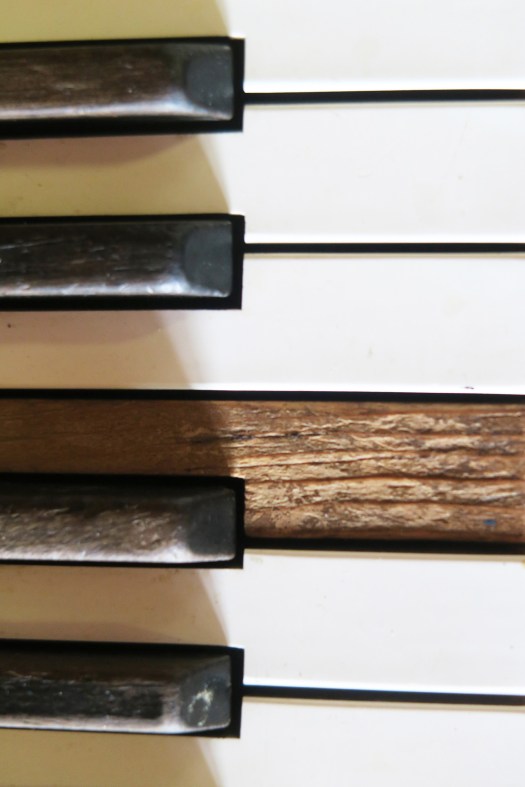
Piano Keys sm

This poem was published in the journal Tyuonyi in 1992. “Tyuonyi” is a Keresan word (and Keresan is a family of American Indian languages) meaning “the meeting place” as well as the name of a major prehistoric ruin in northern New Mexico.

Passacaglia

let the shape
be the sound
of two violins which
as we know
or at least
I can tell you
is if
both are played
with equal intensity
only one
point three times
the sound of one or more
likely the shape
should be
doubled requiring
ten sounding oh come
let us let
a point on a line be
side a parallel
line escape its
apprenticeship in
poverty sink without
guilt to a comma or rise
beelike to more
glorious intersections why not
let me
be a riddle
and you be
consolation
like an edible
pawn or let
the falling
twilight of ash
groves succeed
daylight without
apology with
black birds demoted
acrobats standing low
rather let the shape
be the triangular beauty
of acknowledgment and daily
without regard
for the ratio of mass
to velocity
let the horizon
disappear
into the horizon

Sixteenth Post

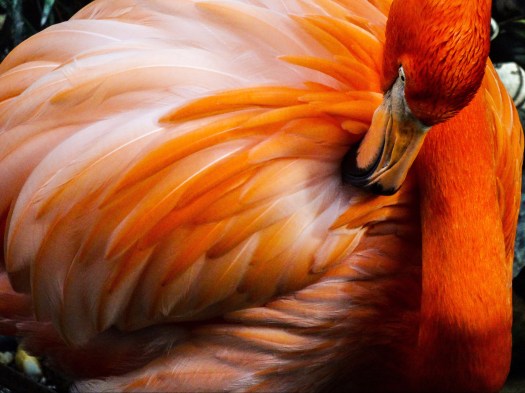
A Flamingo Preens Its Long Orange Feathers

This poem, which I wrote about my father, was published in The North American Review (Vol. 281, No. 3, May/June 1996).


The Discomfort of Reincarnation

If you stare long enough at rain
it becomes
—no
I do not love information.
What I like to believe
is that at the last he was able
to lie down comfortably with no thoughts.
Not even the memory of our last time outdoors together
—his wheelchair parked at the edge of a kidney-shaped lagoon,
he and I nearly covered with ducks, geese and pigeons
grabbing fresh bread in whole slices and reaching for more.

December in Arizona and I was in shorts,
thrilled at the soft warm breasts of the geese
as they pushed against my legs.
He laughed in scattered short syllables that might
have been words.
I cry at the memory of my own complex laughter,
a fact I don’t care to examine.
He could be one of those selfish birds.

Fifteenth Post

DSC00107 b sm

This poem was published in Writ (20th Anniversary Issue, no. 21, 1989).


Body Parts: Love Poem for Sarah

today he found a bag of human
hears in his back
yard weather the two-year-old
ate insects and sucked
wet leaves for five
days alone in the forest analysis when
translated to notes
the genetic codes in mouse
ribonucleic acid play
Chopin’s Nocturne opus 55
no. 1 correction he glued baby
shoes on the deformed goose
so it could walk viewpoints
the peregrine falcons kept the imitation
eggs warm sports rule 8: keep
one container of water
and two sponges in the pit
for rinsing dogs’ mouths during
scratches and switch
sponges with every scratch in
brief he placed the head section
in a heated tank with high-
quality earth nation the assemblyman
called the state mollusk
a bisexual pervert arts the chicken
grew rounder when it
listened to Vivaldi world the winner
of Moscow’s first beauty pageant
wore a tiny bathing suit
and praised perestroika leisure because
alligators have no lips
things go into their mouths
easily at home I love the soft part
between your toes where you
let me keep my fingers

Fourteenth Post

Fire Scorched Trees sm

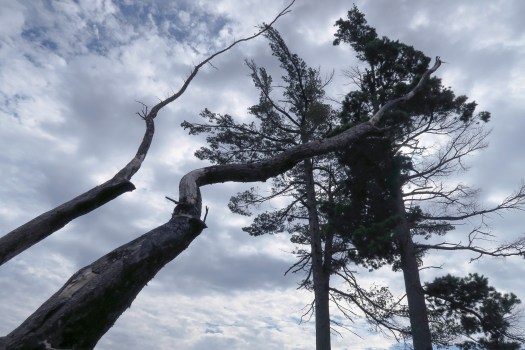
This photo is of fire-scorched trees in the Boundary Waters Canoe Area, northern Minnesota. This poem was published in Denver Quarterly (Vol. 27, No. 3, Winter 1993). The placement of ‘only’ is one of the keys to meaning.

Lightning

To tell the truth

or

How analysis of the effects of disturbances can be reduced

to the calculation of an impulse response


I only want

Let time be the set of integers.

Binary fat fish near the

sheep-colored edge of a continent

Eighteen hundred thunderstorms are

now.

I want only

The map is not bijective.

The boy with three coats on

Who sifts through out dumpster at dusk

A suitable forgetting factor can be

determined

by monitoring the excitation of the

process.

I only have

Seventy-five hundred volts here to go

there.

A tribe of plastic squaws from Hong Kong

Within the fetters of long, straight skirts

Feedforward eliminates measured

disturbance.

I have only

The sound waves of air

heated to fifteen thousand degrees

Celsius.

The catachrestic nouns of my thirties

The profile of her lips in blue mountains

Thirteenth Post

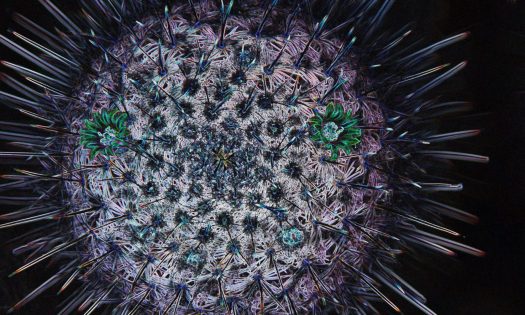
cropped-cropped-abstract-view-of-a-barrel-cactus-in-flower.jpg

Thank you to everyone who has read my poems. Your visits mean a lot to me!

This poem was published in The Cream City Review (Vol. 18, No. 2, Fall 1994).


Rain

In this puzzle piece of desert
snugged close to its neighbors by Joshuas
and the suck of dryness,
death is a softening
—a limp half hour before one reassumes
the unyielding stance of any other day.
But this time your pushed-out arms,
set jaw, and stern face fail to sway me:
I have seen that pose
in wax museums and found it disappointing.
If the guard is away, I want to squeeze
a bloodless hand with my own warm, moist one,
suspecting both will change in some way.
I want to see the head,
tiled a bit more than would be comfortable,
jerk upright and complain.
If you could die again,
I would kiss you in the soft places
and wait like parched ground
for the rain of your complaint.

Tenth Post

IMG_1269 sm


This poem was published in Denver Quarterly (Vol. 29, No. 01, Summer 1994).


My Father at Ninety

sees with a permanent
sort of déjà vu.
We ate here yesterday,
he growls, or,
you already carried that box in here.
The fool as always,
I continue to bring in the box
containing a book he has already read.

Remembering the future
as readily as the past,
he perches, mantislike,
on the fragile leaves of now.
In case time is linear,
the fool plants flowers.
Fools will, he says.

Ninth Post

IMG_1292 cr sm


This poem was published in Writ, 20th Anniversary Issue (No. 21, 1989).


Song of the Mystagogue

You with your announcement of injustice
and you with the names of your friends–

You running sideways from the rules of priests
and you wrapped in the love of your mother–

You with your scarred hammer
and you with your thin line of words–

You with your insider’s wind
and you obsessed with entrapment–

You peering longingly at death
and you with your ancestor’s pictures–

Like those armless ducks standing
on top of the frozen river

Imagine owning nothing
and sing to me.


Eighth Post

CR2_2576 sat cutout

This poem was published in Interim (Vol. 20, Nos. 1 & 2, 1999).


What I Can Tell You

This apple orchard

is the instant your temper came unhinged.

This well-known novel

the instant your wife took new note
of the dark-eyed man in her physics class.

Turn left here, on the street marking

failure to understand

classical music

inability to remember

important instructions.

Count what you love
now count what you’ve lost:

The oxygen you inhale
is the number left over.

Cradled in a crack in the sidewalk
a beetle waits for your shadow to pass.
You darken whole minutes.

This necessity
to crush the space beneath your feet

is the instant a window opens,
scattering birds from the rough sill.

Sixth Post

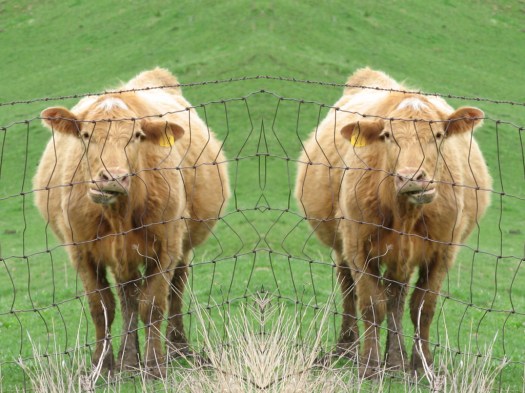
Mirrored Image of a Cow Chewing behind a Wire Fence


This poem was published in The Georgia Review (Vol. XLVII, No. 2, Summer 1993).


Set Theory

A Conversation with My Mother


This circle represents {people}: “the set of all people.”
This second circle, inside, is {tax evaders}:
all tax evaders are people, but not all people
are tax evaders, as far as I know.

This little circle, half inside, half outside the first,
overlapping the second a bit, is {Indiana residents}.
Its elements are Hoosiers. Dogs, cats, and cattle
who live in Indiana are members of this set

as long as they stay out of the big circle.
Some tax evaders live in Indiana.
Can you draw me a circle for {Star Trek enthusiasts}?
How about {Hoosier tax evaders on drugs}?

As if they were having some sort of out-of-body experience
some sets are not members of themselves.
{all things in print} is a member of itself
but {Methodists} is not itself a Methodist

for or against gambling and nonsexist language in the Bible.
{things not Methodist} belongs to itself, and you can
see the problem with {all things not in print}. Do you think
{all sets that are not members of themselves} is a member of itself?

Now draw me a circle of all the good people.
Remember, some are Christians, some are not,
some are blonde, some are illiterate,
some are fine singers, some like pickled beets,

some are homeless, some are homosexuals,
and some have been to Paris. However,
those currently beside themselves with anger
are not members of themselves, so don’t include them.