At the top of the tallest temple whose apex pokes from the snarl of life like a middle knuckle hunched in an exactly square east-facing doorway a monkey sings softly paw curled around nothing beside her.
Along twisted pathways below vines reach for the back of something that ran by a century earlier.
I am the rain carrying an apology to your shoulders.
2
My Love Is a Greedy Deity
Worshipful one, I command thee: bring Bartlett pears—three, or five— slice them so no bruise remains place them in a ring like a child’s drawing of the sun.
In the center, erect an altar of gold filings shaved from the wedding rings of high school sweethearts, and on it pile grains of wheat—seven, or eleven— soaked a week in honey.
Then leave. Seek joy or angst as you will but do not return until I call you. I dine now.
I am the sunlight carrying freedom to your enemies.
3
My Body Is an Unmarked Detour
I stare at you from under bright orange hair that seems to alarm you gesture with my red-bearded chin which takes the rest of my head with it in what could be a yes or a suggestion for you to move.
Is there something you would like to talk about? —my choice of shirt, my lack of a manicure? Can you say anything to clear my doubts? —Do you want me to approach or show myself out?
I am the wind carrying salt to your world.
4
My Memory Is a Dove in the Window
In a dream after her heart attack my mother screamed “Bastards!” a word she’s never said aloud at a circle of grey-bearded men facing her their shoulders hooked forward hands hanging white at their sides like skinned birds.
I am the long-held note carrying answers to your daughters.
—War again
The F-16 cuts through air,
then more air, through clouds,
then more clouds, through whatever is
above clouds
above the round earth
with its prickles of cities,
its patchy fields and scratchy deserts
kept in by dented roads,
its pigs, wolverines,
& cats.
All that under it, &
more: perspective, view,
dreamy vision, memories of
front rooms, school rooms,
hospital rooms,
time striped, hatched,
notched on the face of it,
on the vast open face of it,
nothing subtracted, good
or ill. Nothing
taken away: not memories
of who one is supposed to hate
nor statues of who someone once
admired. Like when S said
emotions are only added,
added to themselves and to each
other, and that my reminder we needn’t
be lonely isn’t right, exactly.
The love is added in, she said:
added in like almonds or copper,
like copper to gold, injected
like insulin, inserted like
a grace note. She said, the night bird will still call us to
wakefulness and we’ll be alone
before we’re together. Together,
I insisted. We are
alone and together,
and we’ll be wistful and satisfied,
and forgetful and reminded.
It’s the blessing in the red ridge
of a scar, she tells me.
The and of living more.
In the night a car plowed sideways through our front yard and left a tall cedar pointing into our bedroom window, like a prosecuting attorney asking who did what, when, where.
“Did you put on gloves?” a friend asked about my being first on the scene. God I forgot. I wanted to save someone. But limber as gymnasts the drunk driver and passenger stuck their landing.
There was that time when Chris came shouting into my kitchen and I tended her cut scalp, tried to get her to call the police, stuck my anger behind my face and just cleaned
the red sink, red counters, red floor. No gloves. No saving.
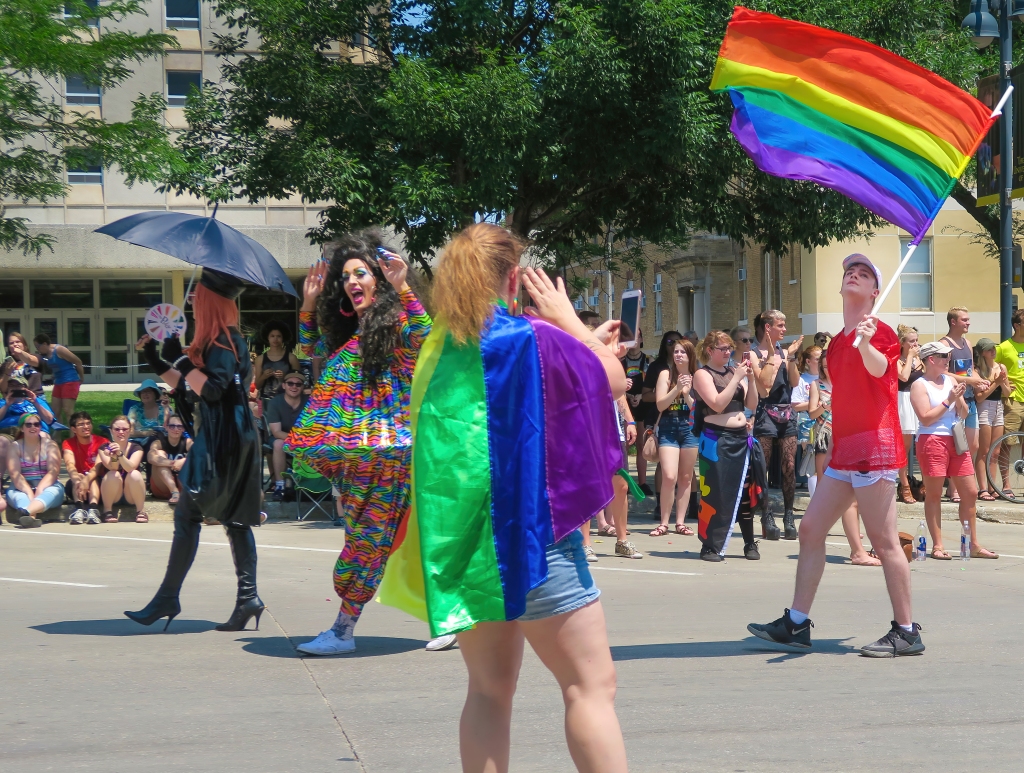
And the time a man who needed a bath and clean clothes heckled us marchers at a Pride parade. Most of the women said Have a nice day and kept walking but he called me a name whose invisible weight
tilted a scale inside me. I didn’t aim for his face and miss. I aimed for his hat brim and it took his head with it.
What were you thinking? my lover shouted as the man walked away fast, muttering. God I don’t know. I wanted to stop him. I wanted
to get his attention. To make him afraid. I wanted to be enormous to save someone.
Returning from Central America I made
the smallest jest at the passport station
and found myself in line C4. Three places
ahead stood a Latino—tall, late thirties
perhaps, crisp white clothes, Panama hat,
shepherding two large bags and a
rolled hammock.
He stood straight and still as they
emptied his bags mechanically,
two factory workers deconstructing, unfolding trousers,
uncoiling a belt, unrolling mated socks, tossing item after item
on the stilled conveyor belt.
He kept his hands in his pockets as they opened bottles and tubes
and poured and squeezed them empty into a bucket
that smelled at first like wheat fields.
He removed his hands from his pockets and hung them
as they opened every envelope and read each letter,
hefted, smelled, and felt the safety razor, hairbrush, and dental floss,
removed the back from a framed picture and separated the photo from
its backing, tapped the heels of tall black boots, unscrewed the barrel
of a gold fountain pen, dropping each item
onto the growing heap.
They spoke, and he removed his hat. They slit the hatband neatly as surgeons. I saw him breathe in when they cut the cord that held the large hammock, pulling the ornate poles from the grip of knotted white loops, leaving them stretched and dangling, close-parentheses in a tight row. They pried off the ends of the poles and peered inside, tilting them like telescopes toward the fluorescent lights above.
The agents closed the line and went away with the man
for half an hour. The rest of us waited, assembling our faces into
nothing. He was buttoning his white shirt as they returned.
After the agents turned to the next person in line, the man labored
to assemble the hammock but gave up, wrapping the pieces
in the stretched body. He worked over his clothes, moving
his large hands through the wrinkled heap of shirts,
pants, envelopes, camera, underwear. Just before I was called
I saw him wrap a belt around his hand and jab it into the solar plexus
of his bathrobe. He stood a moment, hand buried, then went on,
folding a towel, blue with a white monogram.
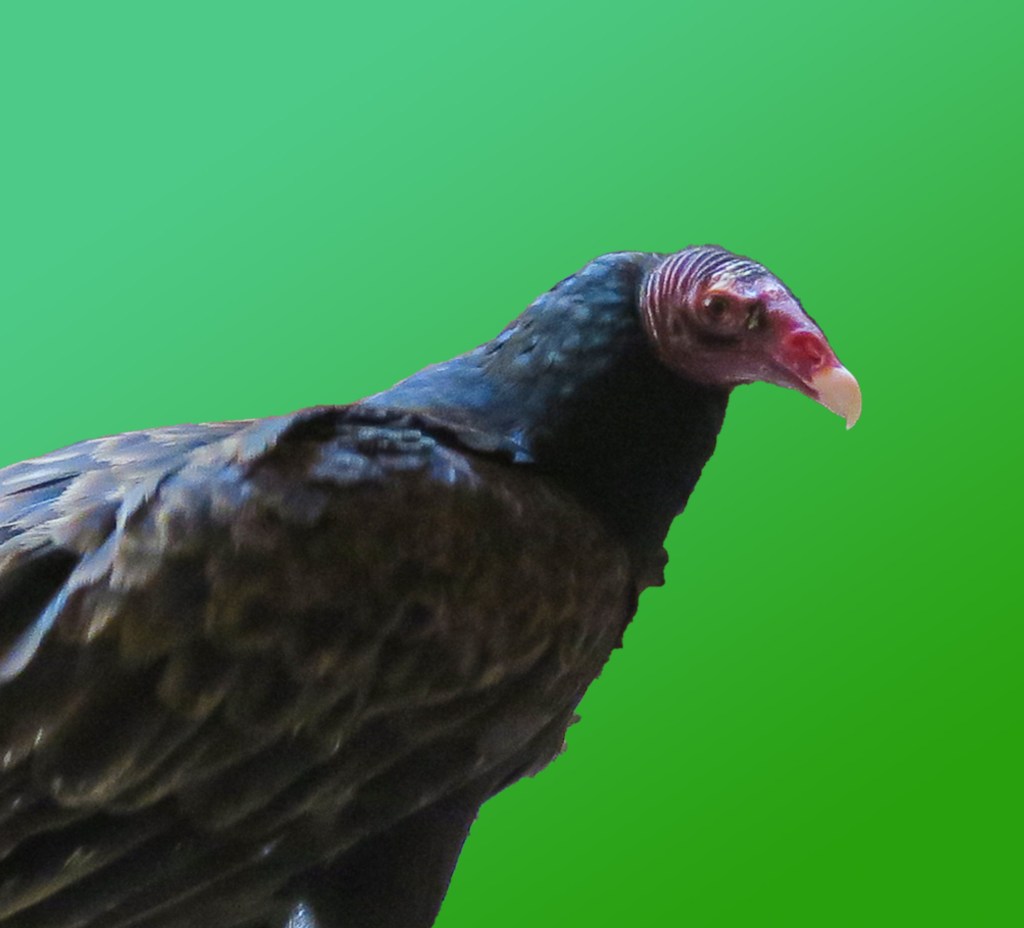
the vulture eats between her meals
   a bottle fly, a pair of eels
a rotting carcass in the ditch
   a taste to make your stomach hitch
to tide her o'er till dinner bell
   a politician straight from hell
putrid, lifeless, soulless lout
   see the vulture crunch his snout
swallow his ears, his fingers, a toe
   spit out eyebrows, the tie must go
even the vulture has her limits
   she vomits him out in a matter of minutes
He feels for the roots
pushing cracked, lined hands through the soft dirt.
He removes the intruding hedge’s dark knots
to spare the thin struggle of a tree.
He wants assurance
that his new lady is the right choice.
He rolls a stone into place while
the earth turns on its axis.
I think of the farm my partner and I didn’t buy,
how we came to this house with no curtains instead.
The landscaper wants to know
if he will be a good parent.
The air smells of dislodged spearmint
and crushed lavender.
The blood blister on his palm swings skyward
as he cups a drooping branch and clips it off.
He does it over and over, the swinging and cupping.
What would mean “I don’t know” in my hands
is a pruning ballet in his,
the tall tree an answer.
I think of the child we didn’t adopt,
of her photo in the book: Kristy.
She had so many letters: ADHD, ODD, PTSD.
My lover couldn’t see the girl
in the forest of letters.
Next spring’s seed catalog lies on the seat
of the landscaper’s truck in the driveway;
a diagram of next year’s garden takes shape in his mind.
He hurries to lay gravel and sand
but loses to the rotation of the earth.
“Want to save this nest for your daughter?” he asks,
laying it carefully on the porch steps.
The daughter we did adopt.
The one to whom I am a good parent
most of the time,
alone in this house.
“Yes,” I say. Yes to the lady, the good
parenthood, the nest. Yes to the removal of roots
that held nothing so strongly that a mistake
couldn’t make it all fall down.
A tree isn’t “tall” except in relation to us,
who are “short.” The heart of a hummingbird
fills the world. Try
to apply this principle to loved ones
who shrink with age,
slow down and speed up according to
the weather, forget where things
are but remember how things were,
what it was like in Columbus Grove, Ohio,
how to tie a clove hitch, or a sheet bend, but who’s that asking am I all right and can I tell her who she is? I’m anonymous as winter and twice as old and she could be too—what’s the point of telling her anything? It’s a red and black flannel shirt I remember, with little rips in the shoulders and soft threads that hang from the cuffs, brushing against me like second thoughts.
forgets that parts of her
are missing
that other parts once
angled for attention
she took time
as if it couldn’t be bent, flattened, eliminated, reordered
and effort
as if it was matter
as if it mattered
as if it could be compressed or exploded, colored in, Photoshopped out
with her everywhere,
twin burdens slung from a yoke
she ignored the warnings all around
the flags, sirens, scars, flashing
beacons, allergic reactions, slaps on the
cheek, fullness, emptiness, the color red,
the lack of color
she had let it go let it all go let it go let the cells
puff up or fall where they would into the cracks in her arms and legs
over the dents in her lips through the tunnels in her scalp
into the empty spaces she’d forgotten
a landfill of woman
a historical dustbin
an entire lost tribe
too remote and ugly to signify



 flyingtrapeze.net